
Share This Article
The promise of “never again” has echoed through modern history as a moral and even legal commitment under international law to prevent the atrocities of genocide, armed conflicts, and mass suffering. Yet time and again, the global community has failed to uphold this pledge or obligation. While powerful nations and international institutions often claim the moral and legal authority to intervene in humanitarian crises, that authority has been steadily eroded. This erosion is not based on a single failure, but through patterns of inconsistency, self-interest, and inaction by the most advanced and developed countries, who promise but do not deliver. Does anyone or any country possess the moral or legal authority to stop human suffering?
Moral authority, in this context, refers to the legitimate moral and legal right to act based on ethical credibility, consistency, and a genuine commitment to human well-being. It is not simply about having power, but about being trusted to use “reasonable power.” This legitimacy starts with the proper recognition of history and man’s inhumanity to man, especially under the cover of war.
Today is April 24, 2026. One hundred eleven years ago, on this day, over 200 Armenian intellectuals were arrested and murdered in Constantinople, marking the beginning of the systematic deportation and mass murder of my ancestors. These events, man’s inhumanity to man, collectively were later coined by Rafael Lemkin, a Polish-Jewish lawyer, as race (genos in Greek) killing (cide in Latin) or “genocide.” Lemkin had escaped the German invasion of Poland in 1939 and eventually reached the United States, where he accepted a teaching position at Duke University. He documented most of the Nazi atrocities in his book Axis Rule in Occupied Europe, where he defined an unimaginable crime as “genocide.”
Several years ago, I took a handful of midshipmen to the Holocaust Museum in Washington, D.C. Lemkin and his work are prominently displayed at the United States Holocaust Memorial Museum (Holocaust Memorial Museum). There is no better place for our next-generation military officers to learn about man’s inhumanity to man under the cover of war than the Holocaust Memorial. Teaching our humanity to our future young officers is critical. General Patton once said, “Moral courage is the most valuable and usually the most absent characteristic in men.” I pointed out to our midshipmen that the cover of war, the dehumanization of men, women, and children, and the use of the military are common threads between the notorious genocides throughout history. Authoritarians commit human atrocities with impunity because of the world community’s previous examples of inaction and silence.
Case in point, I showed our future naval officers Adolf Hitler’s chilling call to action prominently displayed on one of the walls of the Holocaust Memorial, “Accordingly, I have placed my death-head formations in readiness for the present only in the east, with orders to them to send to death mercilessly and without compassion, men, women, and children of Polish derivation and language. Only thus shall we gain the living space [lebensraum] which we need. Who, after all, speaks today of the annihilation of the Armenians?”
Sadly, to this day, except for Presidents Regan and Biden, who properly recognized history, most American Presidents have played word gymnastics, calling the Armenian Genocide atrocities, massacres, killings, to avoid calling it GENOCIDE for fear of offending an ally. This Genocide is well documented at the United States State Department and the Library of Congress, thanks to Ambassador Morgenthau, the Near East Relief Foundation, and our own USC Shoah Foundation.
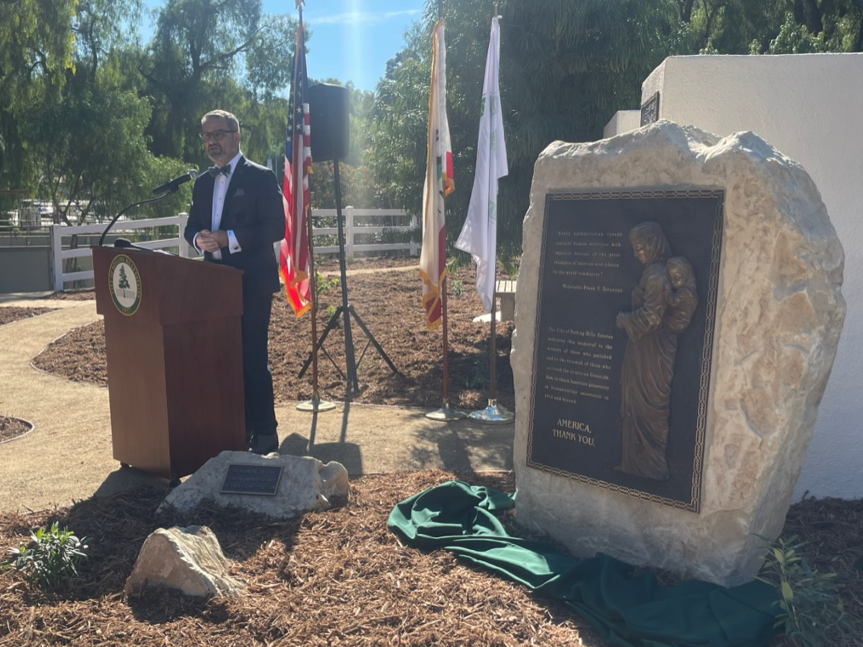
In the realm of humanitarian intervention, clarity in moral and legal authority is essential. Without it, even well-intentioned actions can be perceived as intrusive, manipulative, or self-serving. Over time, this lack of clarity has undermined the moral and legal grounds for intervention. The Rwandan Genocide remains one of the most striking examples of this failure.
Despite clear warning signs and escalating violence, the international community failed to intervene in time, resulting in the deaths of approximately 800,000 people. When intervention appears to depend on political, geopolitical, and financial convenience rather than moral and legal urgency, the legitimacy of those making such decisions is weakened.
Case in point: Artsakh. Armenians inhabited the Trans-Caucasus, including Artsakh, for several millennia. During the Sovietization of this region, to appease Turkey after WWI, Joseph Stalin established the Nagorno-Karabakh Autonomous Region, where 80% of the population was ethnically Armenian living on their ancestral lands, within the Azerbaijan SSR. Under the Bolshevik rule, the ethnic conflicts helped keep the various republics and ethnicities under control. While Artsakh declared its independence several times under soviet law, no one recognized the territory. Years later, at a moment of “perfect storm,” as I wrote in one of my prior essays, Azerbaijan displaced over a hundred thousand ethnic Armenians from their ancestral lands and killed several thousand under the pretext of a completely imbalanced war. The CSTO and the EU betrayed Armenia, for both geopolitical and financial reasons.

Russia’s desperate need to improve its regional standing, Eastern Europe’s and the EU’s dependence on natural gas, coupled with the two nations’ ideological ambitions, created this perfect storm of their national interests to suffocate the Armenian people of Artsakh. To this day, the EU is highly dependent on Azeri natural gas for its energy needs. Azerbaijan exported approximately 12.9 billion cubic meters (bcm) of natural gas to Europe in 2025, accounting for over 50% of its total gas exports. The country has significantly increased its role as a key energy supplier to the continent, with over 10 European countries now receiving Azeri gas through the Southern Gas Corridor.
Sadly, President Trump’s claim of peace between Armenia and Azerbaijan is paid for by the blood and tears of the displaced Armenians. They are also paid for by the Azeri destruction of churches, monasteries, cross stones, and various Christian art representing centuries of Christian faith in the Caucasus.
Today, our lack of moral and legal authority manifests itself in the human toll and the alarming data on Global refugee statistics, which have painted an increasingly dire picture. Global displacement has nearly doubled, rising from about 60 million people in 2014 to over 120 million by the end of 2024, the highest number ever recorded. As of early 2026, global forced displacement has reached critical levels, with over 117 million people displaced worldwide due to conflict and violence, projected to rise to 136 million, creating 42.5 million refugees, according to UNHCR’s 2026 Global Appeal. Sudan, Gaza, Ukraine, Syria, Afghanistan, Lebanon, and Iran constitute the most severe crises, with millions in urgent need of protection and humanitarian assistance. Sudan represents the largest displacement crisis. Gaza has over 1.9 million internally displaced people (roughly 90% of the population). Ukraine has 3.7 million internally displaced, with 5.3 million refugees across Europe.
However, it would be overly simplistic to conclude that moral or legal authority has been entirely lost or that intervention should be abandoned altogether. The erosion of moral authority in preventing human suffering is not irreversible, but rebuilding it will require significant change. Nations and institutions must demonstrate that their actions are guided by moral and legal principles rather than geopolitical or financial expediency. This means responding to crises based on need, not strategic value, and being honest about the motivations behind intervention while being accountable.
Ultimately, the question is not whether the world has the capacity to stop genocide and human suffering based on armed conflicts—it clearly does. The deeper issue is whether it can reclaim the moral and legal credibility necessary to act with legitimacy.
On this April 24, I repeat, “Never again.” The question remains, is any world leader listening?
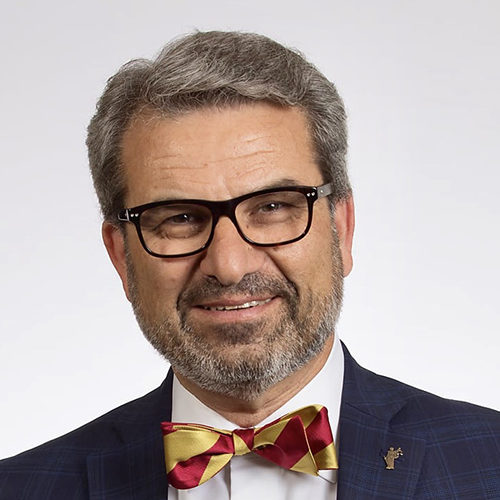
Frank V. Zerunyan is a Professor of the Practice of Governance at the University of Southern California (USC) Sol Price School of Public Policy (USC Price) and Director of Executive Education. He is the founding director of the USC Price Center on National Defense and Public Safety. Professor Zerunyan oversees USC’s Reserve Officers’ Training Corps (ROTC) as the Director and University Liaison for the U.S. Air Force, Army, Naval Reserves ROTC, and Nautical Science Programs.
Professor Zerunyan’s principal areas of expertise include governance, public-private partnerships, civic and ethical leadership, land use, medical regulation, negotiation, and executive education. He lectures locally and globally to build capacity and foster leadership among public executives worldwide. He is the author of books, book chapters, and many short articles published nationally, internationally, and on USC Price’s “Faculty Perspectives.” Professor Zerunyan is often quoted in the media and is a USC resource for journalists as an expert in governance and leadership. He is also an expert on public administration at the United Nations Innovation Branch (formerly Capacity Building Branch).
For his influential advisory role in the Republic of Armenia, he was awarded LL.D. Doctor of Laws – Honoris Causa by the Public Administration Academy of the Republic of Armenia. Professor Zerunyan designs curricula and teaches at the American University in Armenia, Yerevan State University, and the Vazgen Sargsyan Military University in Armenia, with an honorary rank of colonel. He also teaches for the U.S. Navy at the U.S. Naval Service Training Command.
Professor Zerunyan serves on the editorial boards of the Public Administration Scientific Journal for the Republic of Armenia and the Ukrainian Law Review. He is on the board of councilors of Anahuac University Law School, Xalapa, Mexico (Consejo Consultivo de la Escuela de Derecho).
Professor Zerunyan earned his Doctor of Jurisprudence (Doctor of Laws) degree from Western State University College of Law and his Bachelor of Arts degree from California State University, Long Beach. He also completed his advanced legal education in Corporate Taxation at the University of Southern California Law Center (USC Gould). He is a graduate of the California League of Cities’ Civic Leadership Institute.
Professor Zerunyan, trained and practiced as a lawyer, is a four-term Mayor and Councilmember in the City of Rolling Hills Estates, California. He serves on several city, county, and regional policy boards and committees. He was also a gubernatorial appointee under Governor Schwarzenegger, serving 38 million medical consumers on the Medical Board of California.